As capital has become more selective, investors have understandably gravitated toward later-stage, de-risked assets. Pharmaceutical companies have responded by allocating more capital toward licensing and acquisitions of those assets because of their higher probability of success, shorter development timelines, and more predictable returns.
That is a rational investment strategy for an individual company. Whether it is optimal for the industry is a different question.
Suppose every Big Pharma company decides to allocate more capital toward licensing, M&A, and late-stage assets instead of funding risky early research. Individually, each company increases the expected value of its near-term returns. Yet, collectively, the industry may invest less in the innovation that will produce tomorrow’s acquisition targets.
Every company benefits when someone else taking the early risk.
Today’s blockbuster medicines and most valuable M&A targets were yesterday’s high-risk experiments, built on uncertain biology, limited supporting data, and a high probability of failure.
Our industry has repeatedly overcome patent cliffs through internal R&D, licensing, and acquisitions. But those revenue replacements existed only because someone invested in uncertain science years before they became commercially viable.
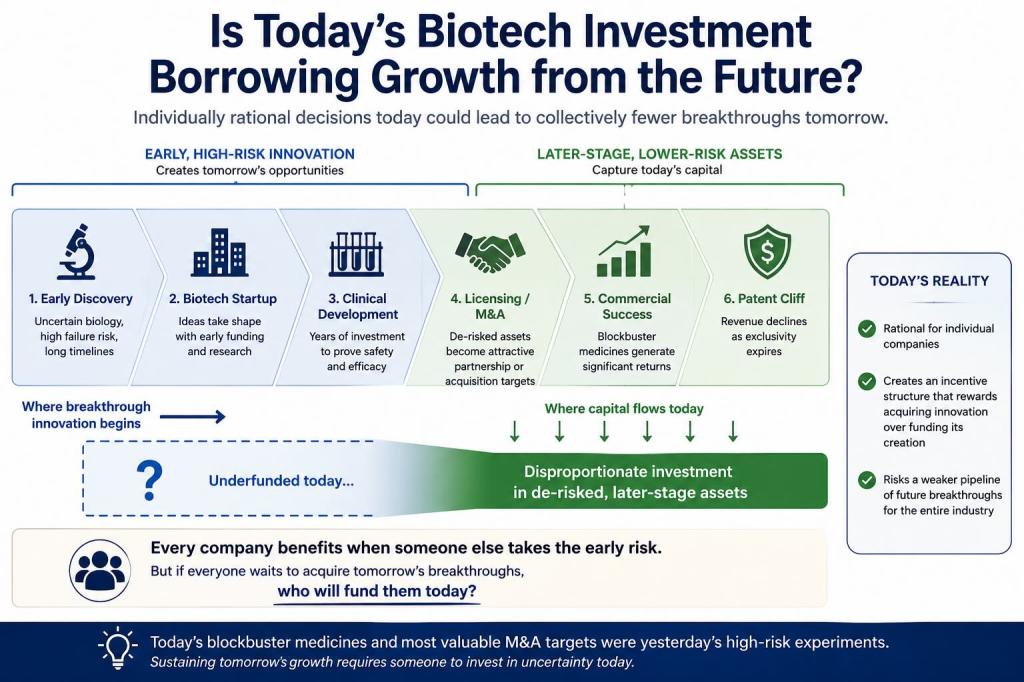
This raises an interesting strategic hypothesis. Perhaps today’s capital allocation, optimized for near-term certainty, creates an industrywide incentive structure that rewards acquiring innovation over funding its creation.
In that case, if everyone waits to acquire tomorrow’s breakthroughs, who will fund them today?
References
1. https://www.drugpatentwatch.com/blog/the-patent-cliff-revisited-predicting-stock-impacts-of-patent-expiry
2. https://www.bcg.com/publications/2025/patent-cliff-threatens-biopharmaceutical-revenue
3. https://www.quantumrun.com/consulting/abbvie-statistics/
4. https://www.sec.gov/Archives/edgar/data/78003/000007800313000006/pfe-12312012xex13.htm
5. https://www.grandviewresearch.com/industry-analysis/keytruda-market-report
6. https://www.zionmarketresearch.com/report/keytruda-market
7. https://www.custommarketinsights.com/report/ozempic-market/
8. Image credit: ChatGPT

